
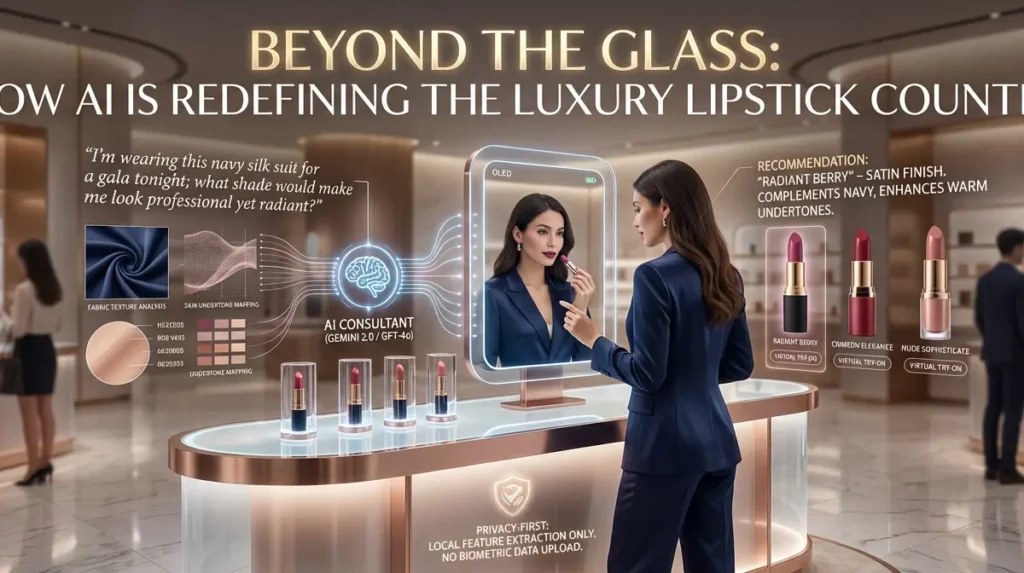
Beyond the Glass: How AI is Redefining the Luxury Lipstick Counter
In the world of luxury retail, the “Display Stand” has long been a static silent salesman. It relied on lighting, branding, and the physical allure of the product to capture attention. But today, a quiet revolution is happening. By integrating Large Language Models (LLMs) and Augmented Reality (AR), the humble lipstick counter is evolving into an intelligent, empathetic, and highly personalized beauty consultant.
Here is how AI is pushing the boundaries of retail innovation.
1. From Static Displays to “Living” Consultations
The most significant leap in innovation is the shift from “selection” to “consultation.” Traditionally, a customer would browse shades manually. With modern APIs like Gemini 2.0 or GPT-4o, the display stand now has a “brain.”
Instead of just clicking a color, a customer can ask: “I’m wearing this navy silk suit for a gala tonight; what shade would make me look professional yet radiant?” The AI analyzes the fabric’s texture, the customer’s skin undertones, and the current lighting to provide a tailored recommendation. This isn’t just a screen; it’s a high-end service experience.
2. The Power of “No-Code” AI Integration
One of the biggest misconceptions in retail tech is that a brand needs to build its own AI from scratch. The true innovation lies in API Orchestration.
By connecting existing, world-class engines—such as Perfect Corp for AR rendering and ElevenLabs for elegant voice synthesis—brands can deploy “Luxury AI” in weeks rather than years. This allows heritage brands to focus on what they do best—aesthetic and quality—while leveraging the world’s most advanced algorithms for the “digital brain.”
3. Privacy-First: Innovation through De-identification
As technology becomes more invasive, luxury must remain synonymous with safety. The next generation of display stands innovates through Privacy by Design.
Rather than uploading a customer’s face to the cloud, smart stands now use “local feature extraction.” The device identifies the HEX code of the user’s skin tone and the RGB values of their outfit locally. Only these mathematical parameters are sent to the AI. This creates a “Private Luxury” experience where the customer gets personalized advice without ever worrying about their biometric data leaving the counter.
4. The “Magic Mirror” Effect
Innovation is also found in the visual fidelity of AR. Today’s AI-driven displays can simulate the exact texture of a lipstick—be it matte, satin, sheer, or metallic. By tracking the user’s lips with sub-millimeter precision, the “Virtual Try-On” feels like a magic mirror. It removes the hygiene concerns of physical testers while providing an instant, “Insta-ready” visual gratification that drives immediate sales.
Conclusion: The Future is Conversational
The display stand of the future is no longer a piece of furniture; it is a service touchpoint. By combining the analytical power of LLMs with the visual magic of AR, luxury brands can provide a bespoke, secure, and enchanting shopping journey.
The glass is no longer a barrier—it’s a gateway to a personalized beauty world.